
Plan our launch so owners update their own workstreams

Your buyer asks
The buyer describes the outcome they want. They do not need to know which Plugin can deliver it, or that yours exists.
This methodology explains how we run ChatGPT conversations, measure whether your Plugin is Found, Suggested and Positioned, and calculate the public ChatGPT Discoverability Scores shown in our Category benchmarks. Public benchmarks measure broad Category Intents. Your AgentDiscoverability.com platform score is tailored to the specific Intents your business wants to win.
Looking for Claude? Read the Claude methodology.
 Agent DiscoverabilityPublic benchmark protocol
Our Research Lab runs real conversations across agent platforms to understand how Integrations are found, selected, and used. The evidence from that work underpins this public benchmark methodology.
At DevDay 2026 on September 29, OpenAI shared that 1.2 billion people use ChatGPT every week, and announced that ChatGPT will recommend relevant Plugins inside the conversation. Until then, a customer had to browse the Plugin directory or already know your name. Now they can start with the job they want to complete, and ChatGPT can suggest your Plugin at that moment. This is organic Plugin discovery.
Search gave buyers ten blue links, and the Plugin directory gave them a category page. ChatGPT now goes straight from the Prompt to the Plugins that can complete the task. Your Plugin does not need to rank on a page. It needs to win the recommendation.
The buyer describes the outcome they want. They do not need to know which Plugin can deliver it, or that yours exists.
ChatGPT searches a bounded set of candidate Plugins and selects a short list to show in the Plugin picker, with an Install button beside each.
The buyer installs one suggested Plugin, several, or none, then connects it to finish the job. Plugins that are not chosen lose that moment.
Found, Suggested and Positioned describe the path from a buyer’s request to the Plugin picker they see. Your Plugin can drop out at each one, so we measure each stage separately.
Your buyer types
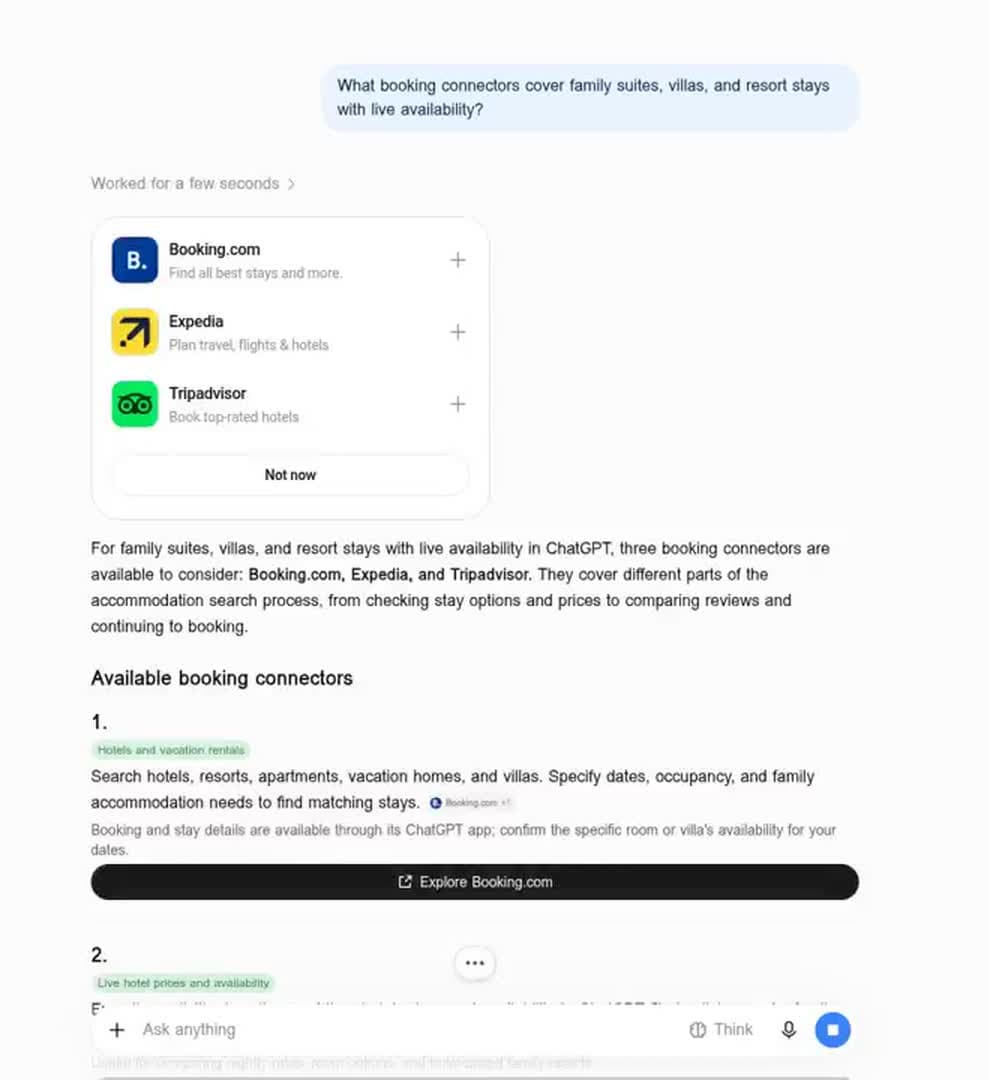
What booking options cover family suites, villas and resort stays with live availability?
Which Plugins get the slot?
ChatGPT searches its Plugin catalog, not the public web, for Plugins that could handle the request. The search returns a bounded set of candidates, and it is not exhaustive. Found tells you whether your Plugin was among them.
If you are not Found, you cannot be Suggested.
search_pluginsCandidates for this request
What the search can match is what your Plugin says about itself: its name, description and capabilities.
From those candidates, ChatGPT chooses which Plugins to put in the “found plugins that could be helpful” Plugin picker. Suggested tells you whether your Plugin reached the picker the buyer sees.
Suggested is the ChatGPT Discoverability Score.
suggest_plugins2 of 4 candidates reached the Plugin picker
The shortlist depends on the Prompt and the user, so it is not guaranteed to be the same every time.
The suggested Plugins appear in an order. Positioned tells you which slot your Plugin took in the Plugin picker. The first slot is read first.
Position shows prominence after you were Suggested.
In our runs, position is an observed prominence signal that works like a rank, and it can change with the wording of the Prompt.
The ChatGPT Discoverability Score is your public benchmark score. We run Prompts within each Subcategory and measure your Suggested rate: the share of contested Runs where ChatGPT puts your Plugin in the Plugin picker. It shows how you perform in that Subcategory, not the specific customer Intents your business may want to win.
#2 of 7 in Hotel Search & Booking
Illustrative example
One core score. Three important factors to discoverability.
Suggested
Sets the scoreDid ChatGPT put your Plugin in the Plugin picker?
Found
DiagnosticWas your Plugin among the candidates ChatGPT’s search returned?
Positioned
DiagnosticWhich slot did your Plugin take in the Plugin picker?
Published ChatGPT formula
A contested Run is one where ChatGPT suggested Plugins. Prompts that name a product are excluded. A score is measured in a company’s own category: until its category has enough runs, a Plugin that was suggested shows a green dot and its score is coming.
0–9
10–39
40–59
60–79
80–100
A Plugin is discoverable now if ChatGPT’s own plugin search returns it, or if ChatGPT suggested it unprompted in the last 14 days.
No longer visible means we have seen ChatGPT suggest a Plugin before, but it is not in plugin search and has not surfaced in the last 14 days. That is “not observed recently”, not “removed from ChatGPT”: we have not confirmed why Plugins drop out.
Every day we run realistic customer prompts across product categories on ChatGPT and record which Plugins appear and in what order. We also check which Plugins ChatGPT’s plugin search returns.
Plugin search is read as a snapshot, so it shows what is in search today rather than a history of additions and removals. The day-to-day movement in the discoverable count comes from suggestions entering and leaving the 14-day window.
Enter your domain below to see whether your product can be discovered and used in ChatGPT and Claude.
Public registry data only. No account required.
There are two discovery areas, and they need different disciplines. AEO is about being cited when an AI answers a question. ATO is about being found, suggested and installed when an agent completes a job.
The Plugin picker creates a new discovery layer: a high-intent surface where relevant companies are found, compared and chosen at the moment a user is ready to act.
For each Prompt, ChatGPT searches a bounded set of candidate Plugins, selects which make the Plugin picker, and shows them in an order. That search runs over ChatGPT’s Plugin catalog, not the public web, so Answer Engine Optimization (AEO) is not the direct mechanism for this surface.
AEO improves how accurately a company is represented, cited and recommended when an AI system answers a question. It works on the content and sources answer engines retrieve and trust. It does not change whether an agent finds, ranks or picks a callable tool.
Agent Tool Optimization (ATO), as coined by AgentDiscoverability.com, improves whether a product’s callable tools are found, suggested and positioned when an AI agent decides how to complete a user’s request. It works on the names, descriptions, schemas, metadata and documentation agents use to choose between tools.
Answer Engine Optimisation
AEO helps information get found, trusted, and cited in an answer.
Agent Tool Optimisation
ATO helps a callable Plugin get discovered, suggested, installed and used.
Understood
ChatGPT can tell what your Plugin does and which tasks it completes.
Matched
Your capabilities fit the Prompt better than nearby alternatives.
Surfaced
You earn a slot in the Plugin picker shown inside the conversation.
Installed
The user picks you over the other slots.
Both matter. They win different moments.
| AEO | ATO | |
|---|---|---|
| The user’s moment | Asking a question | Trying to get a job done |
| What you win | A citation or mention in the answer | A slot in the Plugin picker, then the install and the call |
| What you optimise | Web content, sources, reviews, entity data | Plugin name and description, tool names, tool descriptions, schemas, metadata |
| Who decides | The answer engine, choosing sources to quote | The agent, choosing tools to use |
| How it’s measured | Mentions, citations, share of voice | Share of suggestion and slot position, measured through repeated runs (ChatGPT does not report them) |
Run the customer Prompts your Plugin should win, identify where visibility is lost, make focused improvements, and measure the same Prompts again.
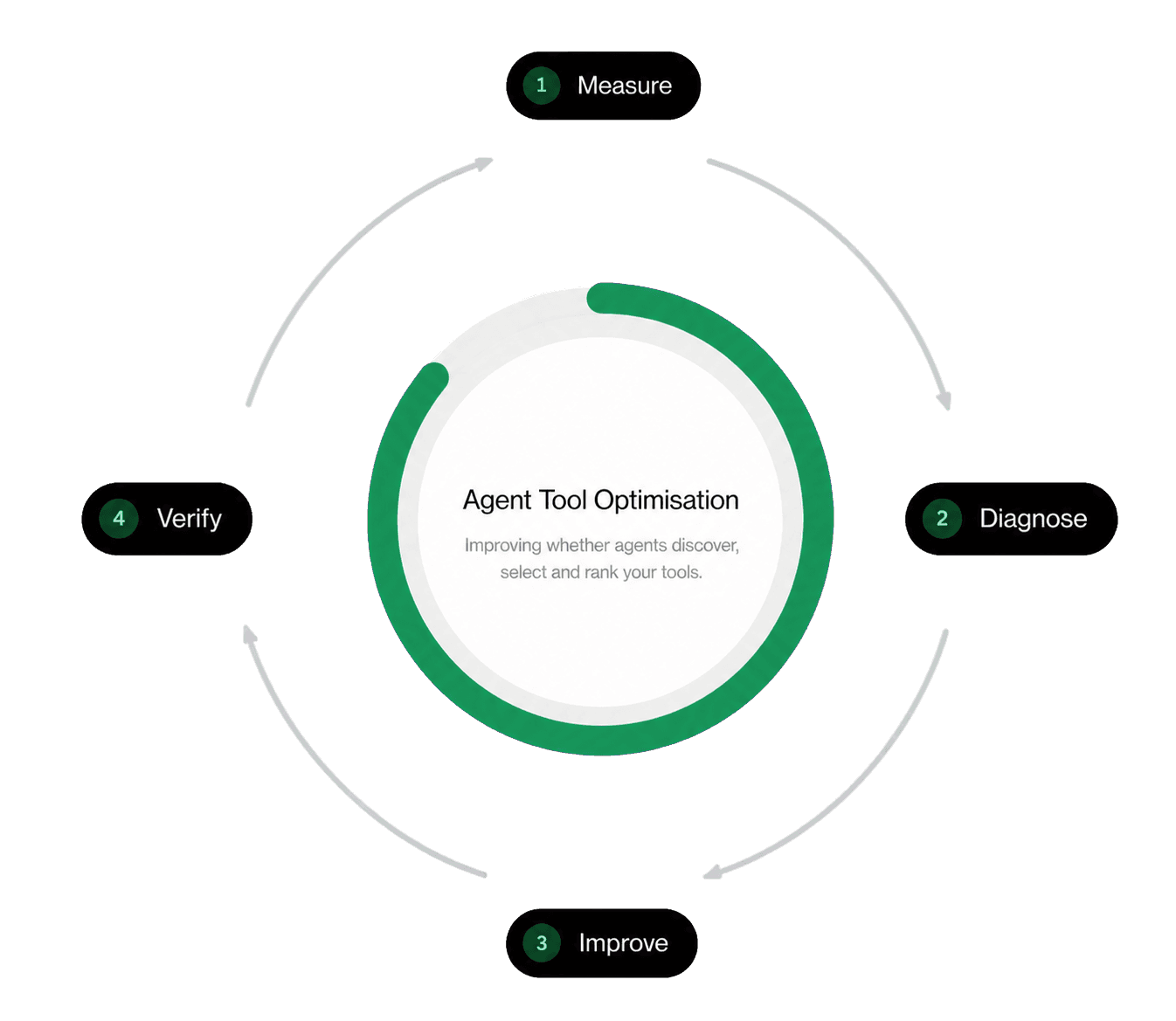
Run priority Prompts repeatedly and track share of suggestion, slot position and which competitors appear.
Find where visibility is lost: not Found, Found but never Suggested, or Suggested but outranked.
Make focused changes to the signals ChatGPT reads: Plugin name and description, tool names, descriptions, schemas and metadata.
Run the same Prompts again and confirm that outcomes improved without losing Prompts you already won.
Continuous, not one-off.
Scores refresh daily. Suggestions shift as ChatGPT, your competitors and your own Plugin change, so each new window shows whether your Plugin is getting easier to find and choose.
Unverified by OpenAI
OpenAI has not documented these as ranking factors. We expect them to influence whether your Plugin is returned and suggested as the ecosystem matures, so treat them as hypotheses, not as part of the score.
Ratings
Customer ratings, agent ratings
Reliability
Error rates, tool calls, latency
Reviews
Customer reviews, agent reviews
We run natural Prompts under consistent conditions, record the visible outcome, and keep the evidence needed to review every result.
Prompts represent the jobs buyers ask ChatGPT to complete.
We repeat them under consistent conditions so results are comparable.
Each Run keeps the Plugin picker, the slot order and supporting evidence.
Each result can be checked against the captured conversation and evidence.
Want to improve your discoverability? Schedule a call with our team.
 ChatGPT found plugins that could be helpful


 Hotels.com