Unstructured Transform
Turn any document into AI-ready structured data
- Category
- AI
- Primary Subcategory
- Document & Message Field Extraction
 View in the Claude registry
Integration details
Description
Unstructured Transform turns real-world documents into clean, structured, AI-ready data. Point it at a file — PDF, Word, PowerPoint, Excel, HTML, email, scanned images, and ~70 other formats — and it returns the content as Markdown, element-level JSON, HTML, or plain text that an agent can act on immediately. Under the hood it runs a configurable pipeline: partition documents into structured elements (titles, paragraphs, tables, lists, images) with layout and page metadata; optionally enrich them with vision-language passes (image and table descriptions, table-to-HTML, named-entity recognition, generative OCR); chunk the content for retrieval; and generate embeddings for a vector store. It can also extract structured JSON from a document against a schema you provide — or draft that schema for you. Work is submitted as an asynchronous job, and results are delivered out of band through a short-lived download link, so even large documents never overwhelm the conversation. Each request handles up to 10 files, 50 MB per file. Common uses: feed specification PDFs into a coding task, ground answers in policy or contract documents, build a searchable Q&A corpus over enterprise files, pull structured fields from forms, invoices, or contracts against a JSON schema, or prepare large document sets for a RAG pipeline. Requires a free Unstructured account. Learn more at docs.unstructured.io/transform.
- Integration type
- Connector
- Verification status
 Verified connector
- Platform
- Claude
- Primary Subcategory
- Document & Message Field Extraction
- Secondary Subcategories
- None listed
- Brand
- Unstructured
- Access
- Account required
- First tracked
- 2026-07-17
- Tool count
- 6
- Geography
- US
The Primary Subcategory used for this profile’s headline score.
Other Subcategories where the Integration is listed.
Get alerts for Unstructured Transform
Get updates when Unstructured Transform’s Discoverability Score or category rank changes.
Claude Discoverability Score
Your Claude Discoverability Score is being prepared
Claude can surface a verified Connector when it matches a user’s Prompt.We are preparing Unstructured Transform’s Discoverability Score and will publish it when the benchmark is ready.
No spam. Unsubscribe any time.
No spam. Unsubscribe any time.
What discovery looks like
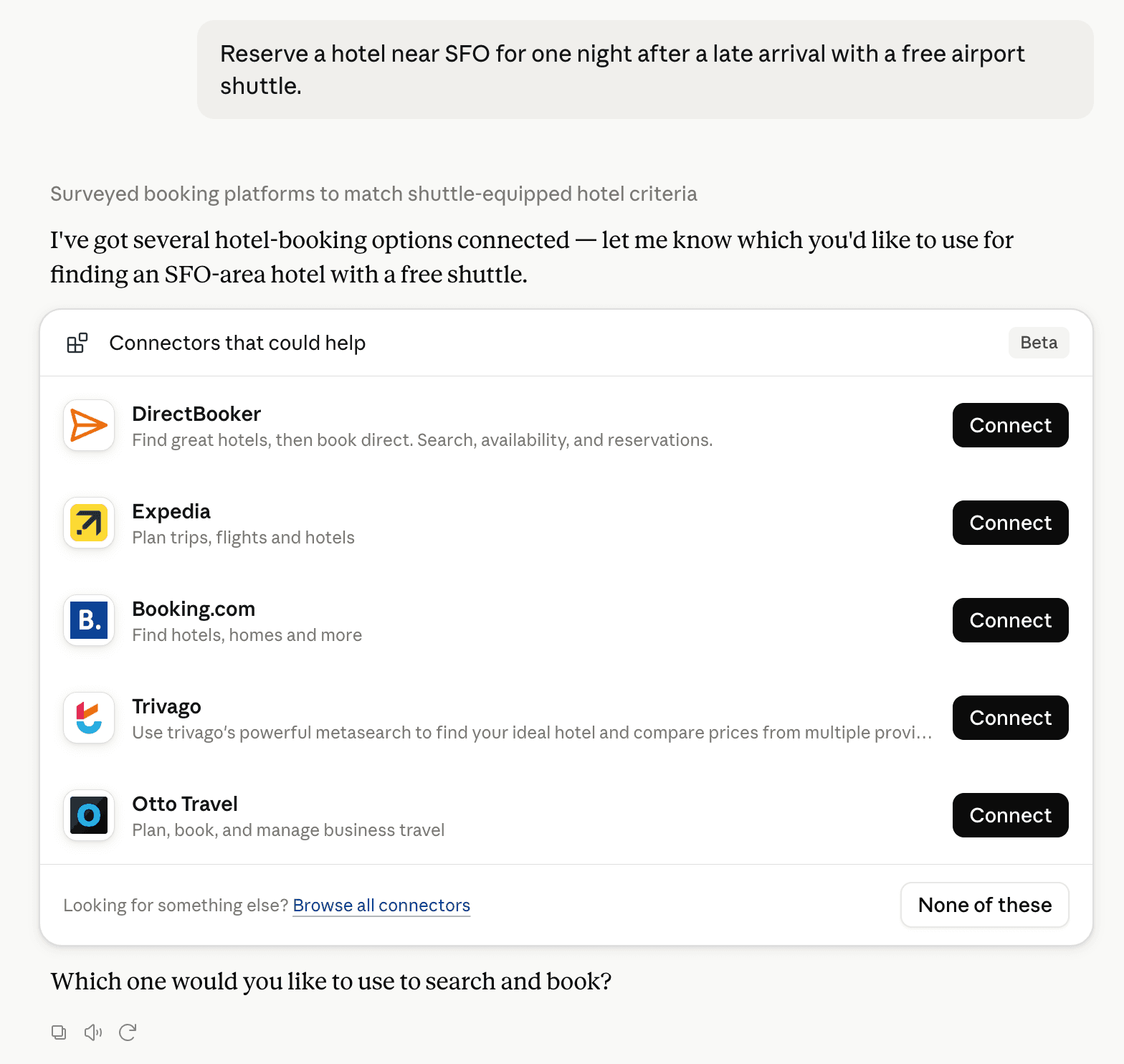
Claude can surface verified Connectors when they match a user’s Prompt.
Competing in Claude Document & Message Field Extraction
View Category6 tools agents can invoke
How do I improve a Verified connector's discoverability?
The levers are the listing surface agents actually read: names, descriptions, keywords, tool metadata, and registry health. Which lever matters depends on where discovery breaks, which is what continuous measurement shows.
What are Unstructured Transform alternatives on Claude?
As of 2026-09-28, Unstructured Transform competes with Aginera, Extend, Inbin, Kamai AI, PhotonCommerce, Pulse MCP in Claude Document & Message Field Extraction, ranked by public Discoverability Score.
Where is this profile measured?
This profile uses the geography attached to the latest public registry snapshot: US. Locale tags are intentionally omitted.