skilder
One place to build, share, and govern the skills and tools your AI agents use at work.
- Category
- AI
- Primary Subcategory
- Shared Team AI Workspaces & Skill Libraries
 View in the Claude registry
Integration details
Description
Skilder is a versioned, governed library for your team's agent capabilities: skills composed with the MCP tools they need, published deliberately, distributed to every connected agent from one endpoint. It picks up where prototypes end: skill copies drifting across repos, live edits changing agent behavior mid-task, tool lists overflowing the context window, no answer to "what did the agent actually do?" With this connector, Claude can: • Learn skills on demand: instructions, files, and tools unlock together, exactly when a task needs them • Execute each skill's tools through server-partitioned read and write channels, under each user's own identity • Run skill scripts (Python, TypeScript, shell) sandboxed on your runtimes • Report friction on skills as it works, so you catch decay before users do • Build new capabilities in conversation (workspace admins): discover available tools, then create, compose, and update skills and roles Lifecycle is engineered in: drafts, publishing, version history, rollback. Agents only see the published state, so you can iterate on a skill while it runs in production. Usage is measured per skill: what runs, what fails, what sits unused. Admins curate which tools are exposed, and every session leaves an auditable timeline. Skills use the open Agent Skills format: import existing folders as-is from GitHub or ZIP. Everything stays portable. Setup takes five minutes: connect, sign in or sign up in the consent flow, and a demo workspace is provisioned. Then bring your own skills.
- Integration type
- Connector
- Verification status
 Community connector
- Platform
- Claude
- Primary Subcategory
- Shared Team AI Workspaces & Skill Libraries
- Secondary Subcategories
- None listed
- Brand
- skilder
- Access
- Account required
- First tracked
- 2026-07-28
- Tool count
- 8
- Geography
- US
The Primary Subcategory used for this profile’s headline score.
Other Subcategories where the Integration is listed.
Claude Discoverability Score
Claude Connector discovery is coming soon
Community Connectors only appear in Claude’s registry.Once verified, organic discovery begins and we can calculate your score.Read more about Community Connector verification.
No spam. Unsubscribe any time.
No spam. Unsubscribe any time.
What discovery looks like
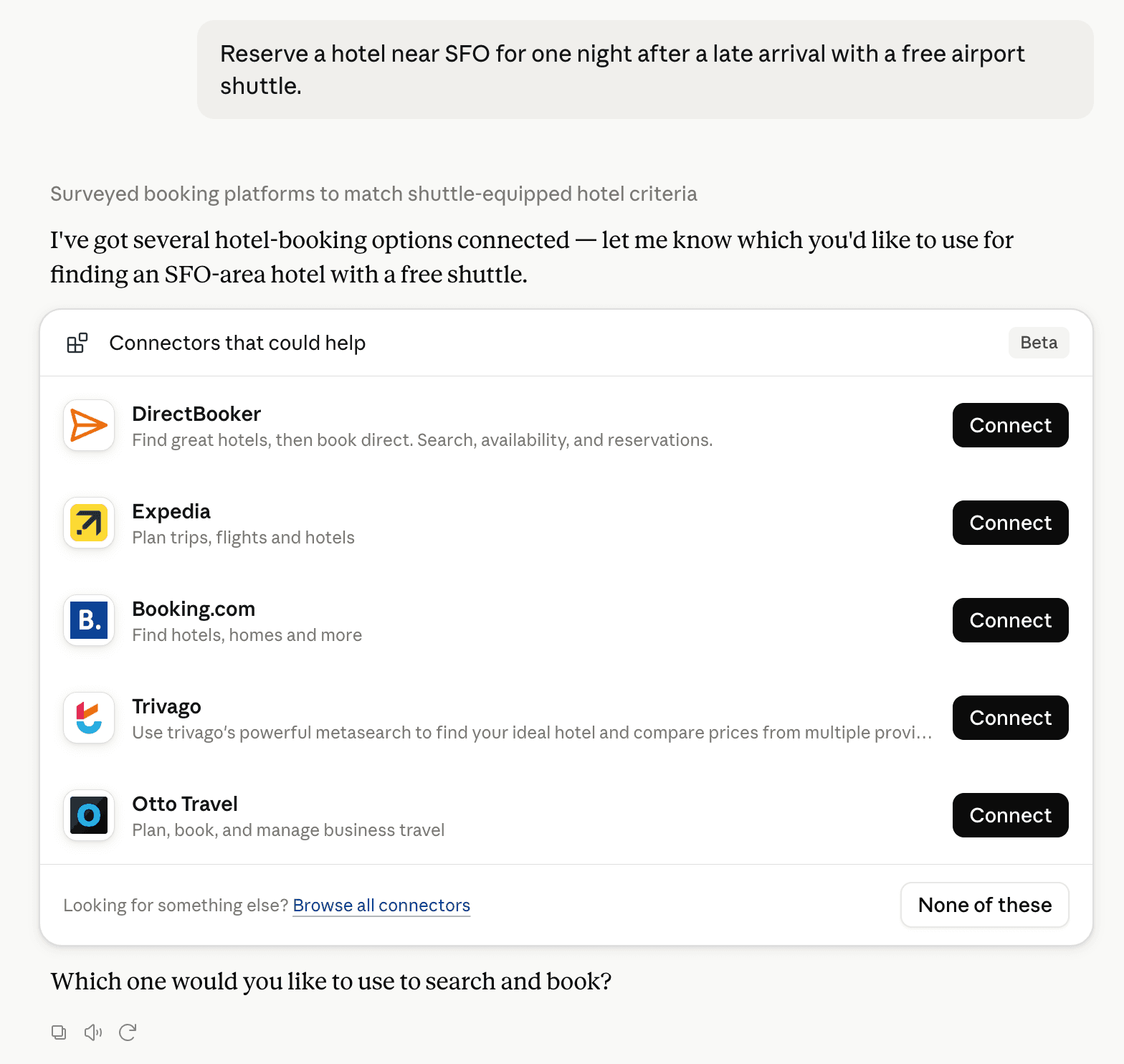
Claude can surface verified Connectors when they match a user’s Prompt.
How Claude Connector discovery works
Your Connector will compete to appear for users’ Prompts once Claude verifies it
Competing in Claude Shared Team AI Workspaces & Skill Libraries
View Category8 tools agents can invoke
How do I improve a Community connector's discoverability?
The levers are the listing surface agents actually read: names, descriptions, keywords, tool metadata, and registry health. Which lever matters depends on where discovery breaks, which is what continuous measurement shows.
What are skilder alternatives on Claude?
As of 2026-09-28, skilder competes with agent-wiki, AgentGrid.io, Automo, Everythings, Expertise AI, Fieldwerk, Lawve AI, Memco Shared Memory, Plainpaper, SkilzVolt, Steady, TextExpander, Vibsync, Wyatt in Claude Shared Team AI Workspaces & Skill Libraries, ranked by public Discoverability Score.
Where is this profile measured?
This profile uses the geography attached to the latest public registry snapshot: US. Locale tags are intentionally omitted.