
TL;DR
In six months, the two largest AI clients have gone from a combined 200 third-party integrations to nearly 1,600. The discipline of getting your product chosen by an agent, what we call Agent Tool Optimisation (ATO), now has a measurable surface. Here is what the data shows, and what it means for any business that sells to, through, or alongside agents.
All data in this report comes from the AgentDiscoverability Registry Tracker at AgentDiscoverability.com/track, the live registries tracker for ChatGPT Plugins and Claude Connectors.


Chapter 1: Why this matters
OpenAI and Anthropic are putting real weight behind these stores. The ChatGPT Plugin Store and the Claude Connector Store are not side projects. They are the surfaces both companies are using to extend their chatbots into agents, plugging in real software, real services, and real action-taking, so that an answer in the chat becomes a transaction in the world. Every signal the two providers are sending says the same thing: the Apps SDK, the public Connector directory, organic in-conversation surfacing on Claude, faster review pipelines on ChatGPT. This is where they are investing distribution.
And it isn't just OpenAI and Anthropic. Every major LLM chatbot and agent player is moving in the same direction. Google with Gemini, xAI with Grok, and OpenAI's own coding agent Codex are all building or expanding their own agent-callable surfaces. The whole category is converging on the same distribution layer, on the same underlying protocol (MCP), at roughly the same time. The ChatGPT and Claude stores are the two with the deepest public registries, which is why they are the focus of this report. But they are the leading edge of an industry-wide shift, not isolated bets.
That shift opens a new distribution paradigm. Search rewarded the operators who got ranked. App stores rewarded the operators who got listed. This new layer rewards the operators whose capabilities get called by an agent at the moment of intent, and the surface where that call happens is the one inside the agent's own client. The unit of distribution shifts from a destination a human visits to a capability an agent reaches for. The competitive question shifts with it: not "how do I get found?" but "how do I get chosen, in this conversation, for this task, against the rest of my category?"
The practice of competing inside this new paradigm, making a business's capabilities discoverable, selectable, and reliably invoked by the agents acting on behalf of its customers, is what we call Agent Tool Optimisation (ATO). The full framework, methodology, and measurement primitives are set out in our ATO thesis. This report is the first quantitative companion to it: a primary-source look at the two stores which play a part in how you can optimise to be discovered by agents.
Chapter 2: A quick primer
The shift underneath all of this is a move from the fragmented web to the intent-based web. On the fragmented web, you searched, you navigated to a destination, and you used a UI to get a job done. On the intent-based web, you prompt, and the tool comes to you, inside the conversation.
MCP (Model Context Protocol) is the open standard that makes that possible. It is the wire format between the model and the software it calls. MCP apps are how that protocol shows up productised inside a chat client: a set of tools the model can call, with optional UI widgets the model can render back into the conversation. ChatGPT calls them Apps. Claude calls them Connectors. Different productisation, same underlying standard.
For builders, MCP apps work through three components: the chat client (where the prompt happens), the MCP server (where the tools live), and the widget (the UI the server can push back into the chat). Tool descriptions are the primitive that determines which app the model reaches for, which is why the discipline of writing them well is the new SEO of this era.
That is as far as this report goes on the how. For a fuller walkthrough including the three-component architecture, principles for building these apps, and the patterns we see across the App Store, see this video from the co-founder of AgentDiscoverability.com, speaking at MCP Dev Summit.
Chapter 3: Where this data comes from
Every figure in this report is drawn from the AgentDiscoverability Registry Tracker, the oldest continuous record of the ChatGPT Plugin Store and the Claude Connector Store. We have tracked both stores daily since each one opened, with no gaps. As of this report, that history spans 175 consecutive days of daily snapshots: nearly six months of unbroken coverage.
The tracker covers:
- Every visible app and connector on both platforms, refreshed daily
- Tool-level and authentication-level intelligence on every integration
- Brand and category benchmarking, so any operator can see how they sit inside their own family
- Historical first-seen, last-seen, and category-shift records on every entry
- New this week: an organic Claude appearance signal, surfacing which connectors are being suggested by Claude for prompts inside each category
All registry data is open source, free, and exportable into any AI client. The tracker is currently used as a source by reporters at Bloomberg, The Wall Street Journal, CNBC, and Modern Retail.
The tracker lives at agentdiscoverability.com/track.
The oldest continuous record of the ChatGPT Plugin Store and Claude Connector Store. 175 days, zero gaps, fully open source.
Chapter 4: The growth trajectory
The clearest signal in the tracker is how quickly these two registries have become real distribution surfaces.
Over six months, ChatGPT has grown roughly 9.7× and Claude roughly 5.2×. Both curves are still steepening.
End-of-month visible counts
| Month | ChatGPT | Claude |
|---|---|---|
| Dec 2025 | 122 | 81 |
| Jan 2026 | 207 | 137 |
| Feb 2026 | 406 | 174 |
| Mar 2026 | 810 | 247 |
| Apr 2026 | 1,040 | 352 |
| May 2026 (so far) | 1,178 | 419 |
What is driving ChatGPT's curve
There are many factors contributing to the growth; of course OpenAI's own internal decision making around when to ramp up being central. One of the largest structural changes behind ChatGPT's hockey stick has been the review process. At launch, getting an app approved into the store took months. By March 2026 it was taking under a week. The data confirms exactly when that change took hold: across March 2026, the tracker recorded seventeen separate days with more than one hundred net additions to the ChatGPT Plugin Store, peaking at +174 on March 27. That is the data signature of a backlog flushing through a streamlined review pipeline at the same time as an explosion of new applicants reached the front of the queue.
What is driving Claude's curve
Claude's growth has been more linear. Anthropic had its own pickup, but has more recently held the line as it tests organic surfacing rather than chasing pure directory growth. The Claude review process is, as of this report, longer than ChatGPT's.
Our read of the data is that Claude is likely to see a ChatGPT-shaped spike once Anthropic automates more of the connector approval pipeline and decides it wants to more aggressively bring in more connectors. It's worth mentioning, we are seeing big brands get through the review process faster and be accepted into the Claude Connector store ahead of start ups or smaller companies.
Caveat: visibility is not usage
Everything in this report is grounded in what is publicly visible on each store: the data in the registries themselves. We measure what is listable. We do not have usage data for ChatGPT, so the ChatGPT curve should be read as supply, not demand. We do have usage data for Claude, and we will be releasing it very soon and adding it to the tracker.
Chapter 5: The category map
This is where the data gets genuinely useful, because it tells an operator whether their category is contested or wide-open.
ChatGPT and Claude are inverted ecosystems
The single most striking pattern in the category data is that ChatGPT and Claude are inverted ecosystems. Productivity is the only family where the two platforms are perfectly tied, at exactly 138 integrations each. Everywhere else, one platform leads the other by a wide margin.
ChatGPT is the consumer surface
ChatGPT's category mix skews toward consumer-led families:
| Family | ChatGPT |
|---|---|
| Travel & Hospitality | 267 |
| Commerce | 251 |
| Finance | 208 |
| Productivity | 138 |
| Operations | 133 |
| Data & Analytics | 150 |
| Consumer & Lifestyle | 92 |
| Education | 83 |
| Content & Design | 82 |
Travel, Commerce, Consumer & Lifestyle, Education, and Health & Wellness are all categories where ChatGPT outnumbers Claude by 5× or more. If your buyer is a consumer making a decision inside an everyday context, like a booking, a purchase, or a tax filing, ChatGPT is, today, the surface where that buyer is.
Claude is the work and developer surface
Claude's category mix skews in the opposite direction:
| Family | Claude |
|---|---|
| Data & Analytics | 169 |
| Productivity | 138 |
| Developer Tools | 91 |
| Finance | 90 |
| Content & Design | 77 |
| Sales & CRM | 42 |
| Operations | 36 |
| Travel & Hospitality | 34 |
Claude actually leads ChatGPT in Data & Analytics, Developer Tools, Customer Support, and Security. This is the legacy of Claude as the coding-and-reasoning AI for most of 2024 and 2025: the early connector ecosystem was developer-grade and work-grade before it was anything else.
But Claude is now moving into consumer
The most important shift in Claude's category mix happened on April 23, 2026, when Anthropic shipped a coordinated wave of consumer connectors into the Claude Connector Store. The tracker first registered all of the following on that single day: AllTrails, Audible, Booking.com, Instacart, Resy, Spotify, StubHub, Taskrabbit, Thumbtack, Tripadvisor, Uber, Uber Eats, and Viator. Several of these were the connectors Anthropic publicly highlighted as the first to be surfaced organically inside Claude conversations.
The implication is that the two platforms are converging from opposite corners. ChatGPT, which started consumer, is pulling in B2B integrations (every major productivity and operations tool now ships an app). Claude, which started developer- and work-led, is pulling in consumer. By 2027, optimising for one surface and ignoring the other will not be a defensible position for most categories.
For now, the practical takeaway: pick your primary platform by where your buyer lives today, but assume both surfaces will be relevant to you within twelve months.
Chapter 6: Inside the apps
Surface-level counts only tell you half the story. The other half lives one layer deeper, in the tools each app exposes.
~30,000 indexed tools, weighted toward Claude
Across both platforms, the tracker indexes 30,344 distinct tools: 18,736 on ChatGPT, 11,608 on Claude. But the per-integration density tells a different story:
- ChatGPT: 16.0 tools per app on average
- Claude: 29.5 tools per connector on average
Claude Connectors are roughly 1.8× denser than ChatGPT Plugins. There are two likely reasons.
The first is audience. Claude skews toward B2B and developer use cases, where the underlying products have richer APIs and more discrete verbs to expose. The second is composability. Builders shipping on both platforms consistently report that Claude composes multiple tool calls per turn more reliably than ChatGPT, which makes denser servers worthwhile. If your agent will only call one tool per turn, you do not bother shipping thirty of them.
Read-heavy, with action-taking visible in the tail
The top tool verbs across both platforms are the same: get, list, search, create. The current ecosystem is read-heavy by design. But the tail of the verb distribution (update, delete, submit, generate, add, set) shows real action-taking already in production. This is not a passive ecosystem of read-only integrations. Agents are already writing back to systems of record across both stores.
Read, write, or interactive: the capability shape of each store
Both stores publicly classify each app on three dimensions: whether it carries an interactive in-chat UI widget, whether it can take a write action, or whether it is read only. The picture below is drawn from each platform's own first-party store metadata, with no derived flags. Buckets are mutually exclusive and sum to 100%.
ChatGPT (1,172 visible apps), bucketed using chatgpt_app_details.app_labels:
| Bucket | Rule | Apps | Share |
|---|---|---|---|
| Interactive (UI widget) | interactive = true | 886 | 75.6% |
| Read & write (no UI) | writes = true AND interactive ≠ true | 143 | 12.2% |
| Read (no UI) | retrievable = true only | 6 | 0.5% |
| Not declared | app_labels is [] / null | 137 | 11.7% |
| Total | 1,172 | 100.0% |
The dominant ChatGPT shape is interactive: three quarters of the store carry an in-chat widget. Cross-validating the app-level interactive label against tool-level widget signals (openai/resultCanProduceWidget and openai/outputTemplate: ui://widget/...) confirms a widget for ~85% of those apps; the remaining 15% are declared interactive without a tool-level widget signal in our index.1
Claude (419 visible connectors), bucketed using claude_connector_store_badges (for UI) and permissions (for read / write):
| Bucket | Rule | Connectors | Share |
|---|---|---|---|
| Interactive (UI widget) | claude_connector_store_badges contains "Interactive" | 54 | 12.9% |
| Read & write (no UI) | No Interactive badge AND permissions ∈ {Read and write, Read + Write} | 93 | 22.2% |
| Read (no UI) | No Interactive badge AND permissions ∈ {Read, Read only, Read Only} | 115 | 27.4% |
| Not declared | No Interactive badge AND permissions is NULL | 157 | 37.5% |
| Total | 419 | 100.0% |
The Claude "Not declared" bucket is large, but it is structural rather than missing data.2 Among connectors that have a declared permissions tag, the read-vs-write split is roughly 53 / 47, meaningfully more write-heavy than ChatGPT's equivalent.
The single sharpest finding when you put the two stores side by side:
| Capability dimension | ChatGPT (1,172) | Claude (419) |
|---|---|---|
| Interactive (UI widget) | 75.6% | 12.9% |
| Write-capable (anywhere) | 37.7% | 28.6% |
| Read-only (declared) | 50.6% | 32.5% |
| Not declared | 11.7% | 37.5% |
ChatGPT was built widget-first. Claude was built tool-first. Three in four ChatGPT Plugins ship with an in-chat rendering surface. Roughly one in eight Claude Connectors does today. The Claude productisation treats the chat as the UI and the connector as a capability the model reaches for. The ChatGPT productisation treats the app as a guest UI that comes into the chat. Apps that exist on both platforms feel different when you actually use them, and this is why.
Both stores are converging on a richer surface where apps read, write, and render. Anthropic in particular has been actively expanding its widget surface. But the starting points are genuinely different, and the numbers above reflect today's reality, not the trajectory.
1 Of the 888 ChatGPT Plugins flagged interactive at the app level, 747 also carry a tool-level widget signal (openai/resultCanProduceWidget or openai/outputTemplate: ui://widget/...). The remaining 141 either declare interactivity without shipping a widget today, or store the widget signal in a tool field we do not currently surface.
2 Of the 157 Claude Connectors in the "Not declared" bucket, 94 are DXT-distributable local connectors (source_feed = dxt, server_type = local): connectors that run on the user's own machine and predate the store-level metadata fields they would otherwise populate. The remaining 62 are older remote connectors added before Anthropic introduced the permissions and badge fields. This is the metadata system being newer than some of the connectors, not Anthropic failing to enforce declaration.
Authentication mix tracks the category lean
At the tool level, the authentication split looks structurally different at first glance:
| Platform | Auth required | Authless |
|---|---|---|
| ChatGPT | 75% | 25% |
| Claude | 68% (auth req.) | 4% (explicitly authless) |
This is not a property of the platforms themselves. Both ChatGPT and Claude support authenticated and authless tools equally. It is a reflection of the category mix sitting on each store. ChatGPT's consumer-led ecosystem (browse a hotel, search a product, look up a stat) has a long tail of legitimately authless surfaces. Claude's B2B-led ecosystem (work data, sales records, dev tooling) almost always requires an authenticated user inside a workplace context. The auth ratio is another lens on the same B2C-vs-B2B contrast already visible in the category map.
Chapter 7: Claude Organic Discovery
Claude organic discovery is now live enough to measure. Until recently, connector discovery was mostly static: a user had to know a connector existed, find it in the directory, connect it, and then use it. That has started to change. Claude is now surfacing connectors organically inside conversations when a prompt suggests a category of need.
This is not just a new interface detail. It is the beginning of prompt-time distribution. If Claude can decide which hotel, travel, research, data, or productivity connectors to put in front of a user before they ever visit a directory, the competitive surface moves from "are we listed?" to "are we the connector Claude chooses to suggest?"
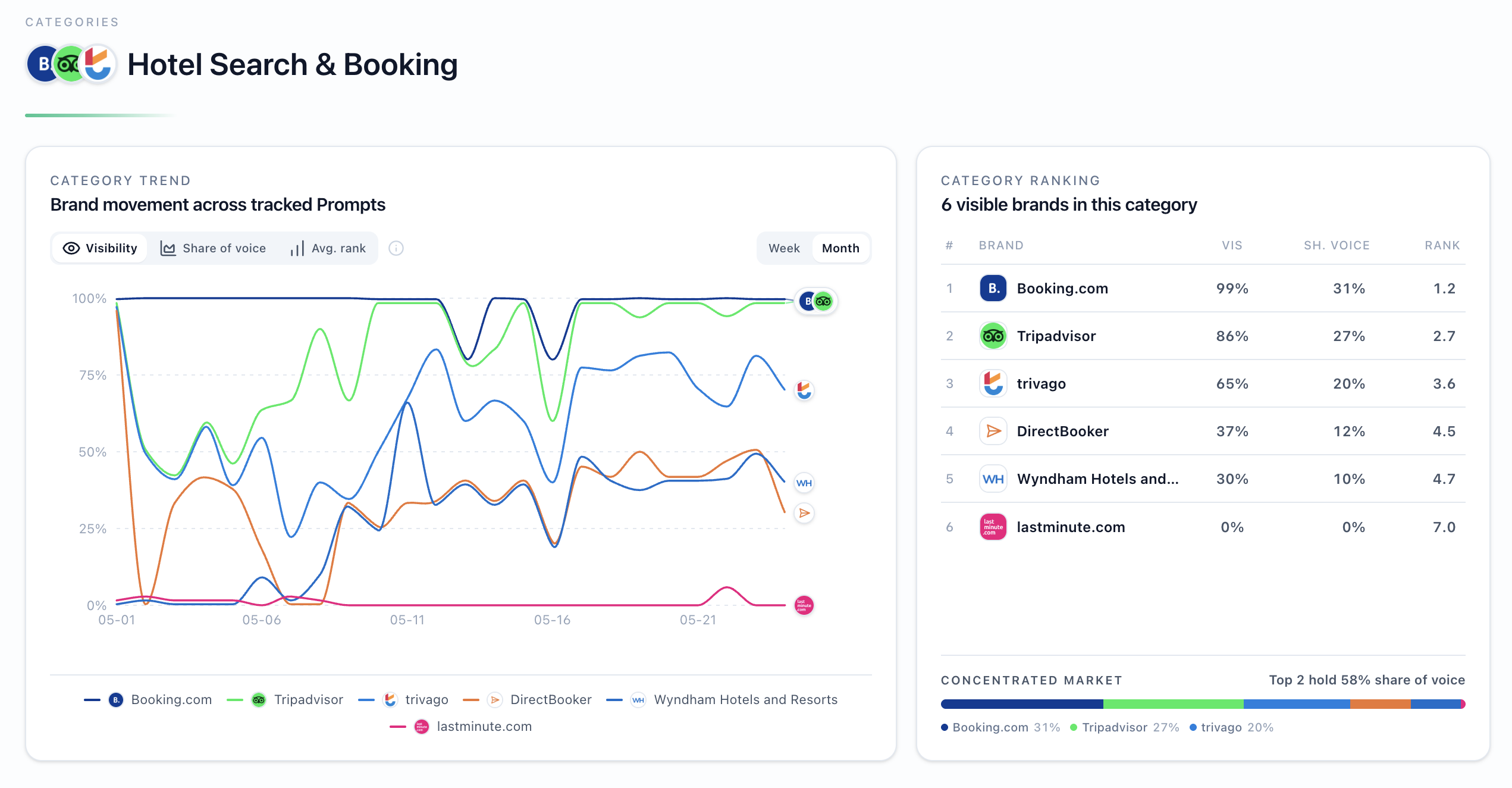
The hotel category is an early glimpse of the kind of signal this creates. We can already see which brands are appearing organically, which ones are missing, and how visibility shifts as prompts and time windows change. In the example above, Booking.com and Tripadvisor hold the majority of visible share, while other hotel brands appear inconsistently or not at all.
But this is only the beginning. Category views are one lens, not the whole system. We are building the measurement layer for prompt-time discovery across categories, connectors, and the prompts users actually ask, including prompts specific to their own market. There is much more in the pipe, and we are already testing it at scale.
We will be releasing this publicly very soon. If you want early access to the private beta, join the waitlist.
Chapter 8: Where else can you find MCP apps?
The ChatGPT Plugin Store and the Claude Connector Store are the two surfaces this report measures, but they are not the only surfaces where the same underlying protocol is shipped. The MCP standard runs across a growing list of AI clients, each with its own directory or marketplace.
ChatGPT Plugins
chatgpt.com/apps
Claude Connectors
claude.com/connectors
 Microsoft Marketplace
marketplace.microsoft.com
Microsoft Marketplace
marketplace.microsoft.com
 Google Gemini Connected Apps
gemini.google.com/apps
Google Gemini Connected Apps
gemini.google.com/apps
 Grok Connectors
grok.com/connectors
Grok Connectors
grok.com/connectors
 Codex Plugins
developers.openai.com/codex/plugins
Codex Plugins
developers.openai.com/codex/plugins
 Cursor Marketplace
cursor.com/marketplace
Cursor Marketplace
cursor.com/marketplace
- ChatGPT Plugins: ~1,200 live. chatgpt.com/apps
- Claude Connectors: ~420 store-visible. claude.com/connectors
- Microsoft Marketplace: Microsoft's single web destination for AI apps and agents, sharing a unified catalog with the in-product Microsoft 365 Copilot Agent Store. marketplace.microsoft.com
- Google Gemini Connected Apps: connected apps for the consumer Gemini app. gemini.google.com/apps
- Grok Connectors: xAI's first-party connector directory plus "Bring Your Own MCP" for custom servers. grok.com/connectors
- OpenAI Codex Plugins: 90+ plugins bundling MCP servers for Codex CLI and desktop app. developers.openai.com/codex/plugins
- Cursor Marketplace: curated plugins including MCP servers, skills, subagents, rules, hooks. cursor.com/marketplace
Build the MCP server once. The same server can ship to most of the surfaces above.
Build once, surface everywhere
Every platform on the list above runs on MCP, and most of them have aligned on the same MCP-app productisation. That alignment is the reason building an MCP server is such a high-leverage move. The same server can ship into multiple stores without being rebuilt for each one. A connector built for Claude can, with minimal adaptation, surface in ChatGPT Plugins, in the Cursor Marketplace, in Codex, in Grok Connectors, and inside Microsoft Marketplace. The protocol is the standard. The store is the wrapper.
That does not mean each store is interchangeable. To actually appear in any of these directories, you have to apply to each one individually and pass its review. The application process varies significantly per client in terms of required steps, documentation, and timeline. Beyond submission, each store has its own ranking signals and its own roadmap for organic discovery. Each is, as we describe it in the ATO thesis, its own black box, and optimising inside each is a per-store discipline. The leverage point is that the work to be present everywhere (the underlying MCP server) is built once. The work to be visible inside each store is per-store.
Chapter 9: What this means for agent discoverability
The most important conclusion from the data in this report is what it signals about where the providers are taking their products. Chatbots are becoming agents. The way they make that leap is by reaching outside their own model weights and calling external capabilities to do useful work: book the hotel, run the query, file the return, generate the report. MCP apps are the primary wiring each of these ecosystems is using to make that happen. ChatGPT's App Store and Claude's Connector Store are the first two public expressions of that wiring at scale, and every other major provider (Gemini, Grok, Codex, Cursor and the rest) is building toward the same thing.
For any business that depends on being found and used by an agent, what we call Agent Tool Optimisation, the implication is direct. Building for agents is a multi-layered exercise. Our ATO thesis describes the four primary channels through which agents reach external capability (the open web, direct API and CLI calls, the agent-to-agent layer, and MCP), alongside a growing set of agent-readable surfaces (AGENTS.md, llms.txt, OpenAPI specs) that help agents understand what your business does before they pick a channel to act through. MCP apps are one slice of that wider picture. But they are the slice the providers themselves are investing in hardest, and they are the only one today where an agent can not only mention your product but actually call it, use it, and complete the action on the user's behalf. That is the structural difference between being a footnote in an answer and being part of the answer.
The practical implications fall in three places: building an MCP app, getting it into the major directories that matter to your category, and starting to optimise for organic discovery as each platform turns it on. The next chapter goes into how to actually do each of those, depending on where you are starting from.
Chapter 10: What to actually do with this
If the conclusion from Chapter 9 is that MCP apps matter, the question this chapter answers is what to do about it. The short version: build an MCP app, get it into every directory that matters for your category, and optimise for organic discovery as each platform turns it on. The FAQ below goes deeper on each of those depending on where you are starting from.
The question every operator we speak to asks at the end of a conversation about this space is the same: what do I do with this? The FAQ below is the version of that answer we currently stand behind.
Should we have an app or connector on these surfaces?
Yes, and the earlier the better. Ranking on both platforms is at least partially usage-based, which means the cost of waiting compounds. Operators who enter while the surface is forming accumulate a usage signal advantage that latecomers cannot easily close. This is the same path-dependence dynamic that defined the App Store era, with the same operating implication: get in early, drive real activations, and the flywheel does the rest.
What do we do if we do not have an app yet?
Three steps.
- Analyse your category in the tracker. Is it crowded or wide-open? Are your competitors there? Who is the current leader by tool count and category presence? The category page is the fastest way to get a current read on competitive density.
- Learn the principles for building MCP apps. Start with Elliot's walkthrough: it covers the practical decisions that determine whether your server gets selected.
- Build the MCP server once, ship to as many surfaces as possible. You want presence across ChatGPT, Claude, and the other clients listed in Chapter 8. The same server can serve most of them.
What do we do if we already have an app?
Two priorities.
- Start preparing for organic discovery on Claude, which is already live. Track your category in the tracker to see which connectors are being organically surfaced for prompts in your space, and use that signal to refine your metadata and positioning.
- Prepare for ChatGPT organic discovery, which is on the roadmap across the industry. The work to be ready for it is the same work that improves your selection rate today: tighter tool descriptions, sharper category positioning, and continuous measurement of how you compare to your peers.
How do we keep up with the changes?
Treat discoverability as a continuous exercise, not a launch event. Models rotate, competitor descriptions improve, system prompts change, store ranking signals shift. The channel is in constant motion. The practical loop is:
- Use the tracker: free, exportable, daily-updated
- Sign up for the newsletter: weekly updates on what changed
- Watch your category for organic discovery shifts as both platforms expand their suggestion mechanics
What is actually new in this release of the tracker?
Brand-level pages, category-level benchmarking, full tool and authentication granularity on every integration, daily updates, and (for the first time anywhere) a public view of which Claude Connectors are being organically surfaced for prompts inside each category. More on the organic signal coming in a follow-up report.
Closing: three takeaways
- The channel is real, measurable, and moving fast. 1,597 integrations and counting. Six-month growth of 9.7× on ChatGPT and 5.2× on Claude. Both curves are still steepening.
- The two platforms are converging from opposite corners. ChatGPT is moving into B2B. Claude is moving into consumer. By 2027, optimising for one and ignoring the other will not be a defensible position for most categories.
- The window to compound is now. Ranking on both platforms is at least partially usage-based today. The cost of waiting is structural, not just competitive. Early entrants accumulate signal that latecomers cannot easily close.
Methodology: All figures are drawn from the AgentDiscoverability Registry Tracker, production data as of May 24, 2026. Daily snapshots run continuously since December 1, 2025. Tracker: agentdiscoverability.com/track
Related reading
- MCP Directory: every ChatGPT Plugin and Claude Connector. Search and compare listings, ranked and updated daily.
- How the Discoverability Score is measured. The benchmark methodology behind every score.
- ChatGPT Plugin discovery: how to get suggested. How ChatGPT decides which Plugins to suggest, and how to get yours picked.
- How to get your Claude Connector discovered organically. A four-stage process to measure, diagnose, improve and verify Claude discovery.
- The MCP discoverability framework. Three foundations and two measurement layers: static and dynamic discovery.