
From chatbots to agents
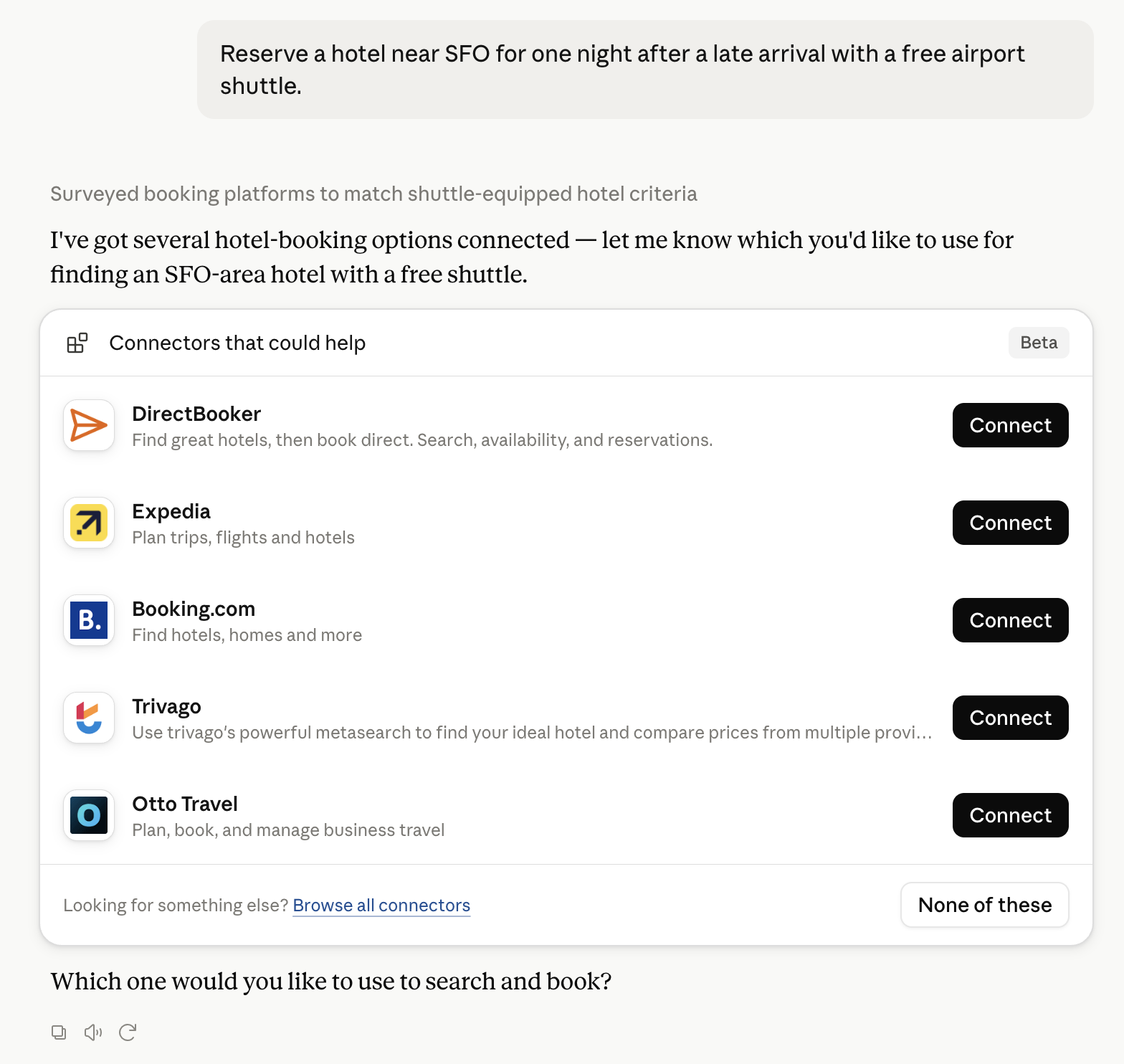
AI platforms are moving from answering questions to completing tasks. Ask Claude to “book me a hotel” and, instead of just returning text, it can identify and surface appropriate Claude connectors. After user selection, Claude uses that connector to bring critical data and a custom interface into the conversation. This creates a richer and far more useful experience without the user having to leave the conversation.
You do not optimize with AEO. You optimize with ATO.
The connector picker creates a new discovery layer: a high-intent surface where relevant companies can be found, compared and selected at the moment a user is ready to act.
Claude does not begin with every available connector. For each prompt, it retrieves the tools it believes may assist the user, decides which should advance into the connector picker and determines the order in which they appear.
Answer Engine Optimization (AEO) improves how accurately a company is represented, cited and recommended when an AI system answers a question. It focuses on the content and information sources that answer engines retrieve and validate. It does not improve whether an agent finds, ranks or picks a callable tool.
Agent Tool Optimization (ATO), as coined by AgentDiscoverability.com, improves whether a product’s callable tools are found, picked and positioned when an AI agent decides how to fulfil a user’s intent. It focuses on the names, descriptions, schemas, metadata, documentation and other signals that help agents discover and choose between available tools.
AEO wins the citation.
AEO helps information get found, trusted, and cited in an answer.
ATO wins the pick.
ATO helps a callable Integration get discovered, ranked, and picked.
Where AgentDiscoverability.com comes in
AgentDiscoverability.com measures and improves this discovery layer. We measure discoverability for your target intents, record which products agents find, select and rank, and identify what agents use to understand each connector. From there, our platform identifies and prioritizes what to change.
Measurement Engine
Know exactly where you stand.See how discoverable your Claude Connector is across the target intents, revealing where agents find, select and rank you against your competitors.
Optimization Intelligence
Win more high-value customer intents.Our platform intelligence identifies the priority changes most likely to improve how agents discover, select and rank your tools.
Accelerator
Bring the plan to life with our team.We work alongside your team to identify the highest-value intents and determine the best optimizations you can make for discovery and selection. Our goal is to make you rank number 1 in your category.
The opportunity for DirectBooker
DirectBooker helps travelers compare hotels and book directly with the hotel. Its Claude Connector brings accurate prices, availability, and detailed hotel content into the conversation, so users can explore options and continue toward a decision without leaving Claude until they are ready to book. Even better, the agent can use this hotel information to guide them to the best possible place to stay.
DirectBooker was already visible when travelers explicitly asked to book direct, use loyalty benefits, or avoid online travel agencies. But it appeared less consistently when people described the hotel they wanted without naming a booking method.
The product could serve those requests – better than any other – but Claude did not always recognize that it should present DirectBooker.
How we improved DirectBooker’s agent discoverability
We applied our four-stage Agent Tool Optimization cycle: Measure, Diagnose, Improve and Prove. Each proven result becomes the baseline for the next cycle.
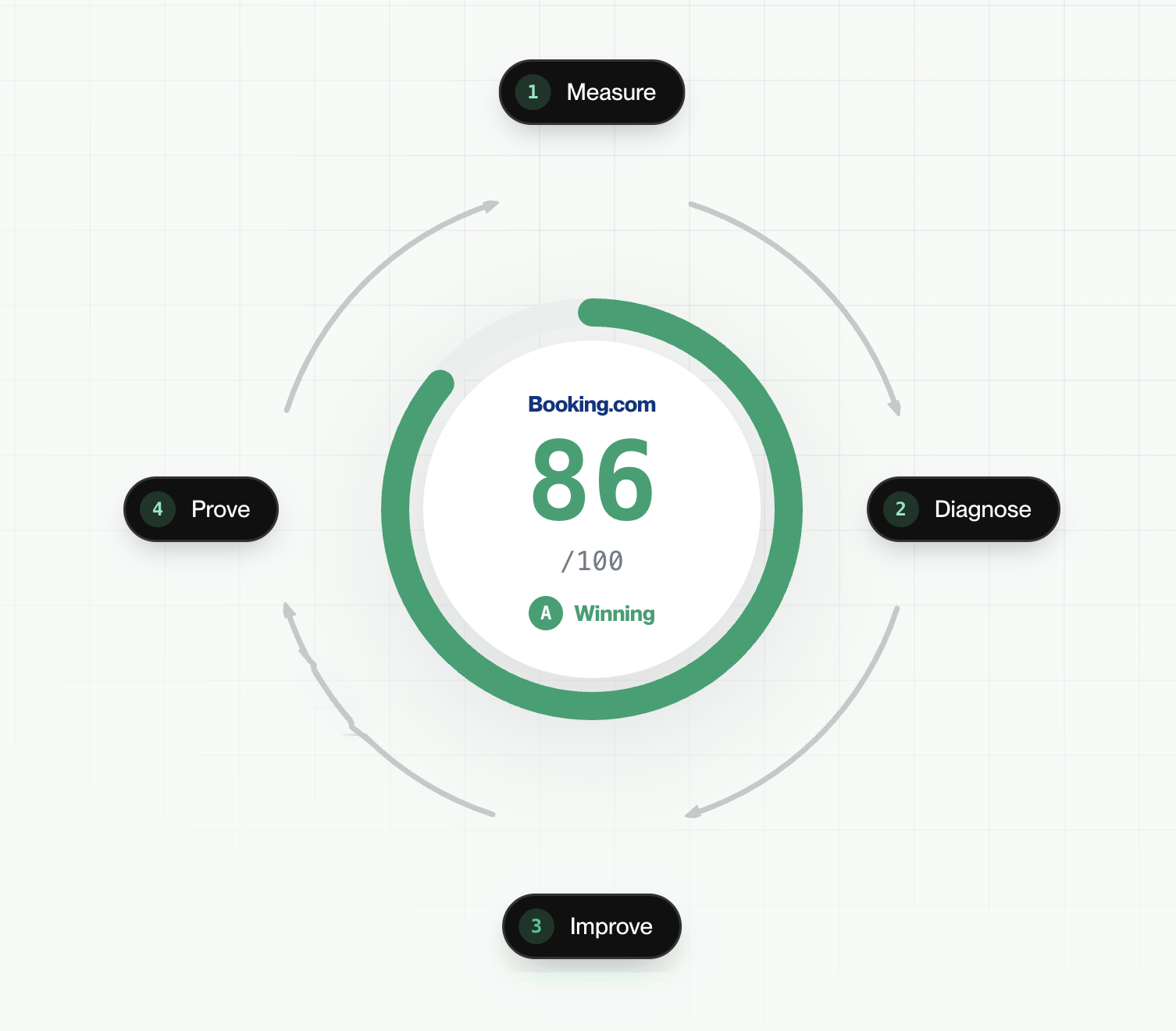
 DirectBooker Agent Tool Optimization
 - 01 Measure
Establish a reliable baseline
First, we worked with DirectBooker to prioritize the commercially valuable customer intents the business cared about winning, rather than generic prompts without meaningful demand. With their decades of experience in the online hotels ecosystem, the DirectBooker team was able to clearly identify what users searched for when they were serious about doing research.
We then created two fixed prompt sets:
- Target intents The hotel-search and booking intents DirectBooker most wanted to win.
- Category overall A broader set of Overall Hotel Search & Booking prompts used to benchmark DirectBooker against the market as a whole.
We ran both sets repeatedly and kept them fixed across each measurement window, giving us a reliable baseline and a like-for-like way to measure improvement.
- 02 Diagnose
Pinpoint where discovery is being lost
We tracked whether DirectBooker was found in connector search, selected for the picker and where it ranked. We combined these signals into a Discoverability Score out of 100, giving us a consistent measure of performance. We then analyzed the results by intent and category position to identify the greatest opportunities for improvement.
- 03 Improve
Make the changes most likely to improve selection
Our platform identified the priority changes most likely to improve discovery, selection and ranking. We worked alongside DirectBooker to implement them and coordinate releases, helping Claude recognize when its connector was the right tool for each intent.
The team’s structured-testing experience, including at Google and Tripadvisor, helped us keep each measurement window clean.
- 04 Prove
Remeasure and prove the lift
We reran the same fixed prompts against the original baseline and looked for consistent gains in discovery, ranking and Discoverability Score. Daily measurement confirmed the improvement was sustained.
Our improvements took DirectBooker to a 100% pick rate
We worked closely with DirectBooker to identify, prioritize and implement improvements designed to help Claude understand when to present its connector.
DirectBooker is now picked for every top-priority intent
Across the intents DirectBooker most wanted to win, its pick rate increased from 31.5% to 100%. Its Discoverability Score increased from 37.8 to 74.1, an improvement of approximately 96%. DirectBooker now matches Booking.com with a perfect pick rate and ranks ahead of Expedia, Tripadvisor and Super.com. For its most commercially important intents, Claude now presents DirectBooker more consistently than some of travel’s best-known platforms.
DirectBooker also ranks second across the wider category
The improvement extended beyond the priority intents. Across the Overall Hotel Search & Booking category prompts, DirectBooker’s pick rate increased from 51.8% to 81.5%, a 57% relative increase. Its category Discoverability Score increased from 48.6 to 67.4, an improvement of approximately 39%. It moved from fifth to second, ahead of every measured competitor except Booking.com.
- 1
 Booking.com91.8%
 - 2DirectBookerCurrent position81.5%
- 3
 Expedia68.9%
 - 4
 Tripadvisor61.3%
 - 5
 Super.com58.9%
DirectBooker shows what focused Agent Tool Optimization can achieve. The improvement reached beyond the intents it most wanted to win, strengthening its position across the wider category. Building a Claude connector makes a product available to an agent. Optimizing its discovery surface helps the agent know when to find, present and rank it.
Increase Your Connector or Plugin Discoverability
Want more people to find and use your Claude Connector or ChatGPT plugin? Talk to our team about the prompts you need to rank for and the optimisations that can improve discovery over time.
Methodology
We used the same two fixed prompt sets and measured discoverability daily. Top-priority intent prompts represented the commercially valuable hotel-search and booking intents DirectBooker most wanted to win. Overall Hotel Search & Booking category prompts represented the category as a whole.
For every run, we recorded whether DirectBooker was Found in Claude’s connector search results, Picked for the connector picker and its Position in that picker. We calculated averages per prompt before averaging across each set, so prompts with more runs did not carry more weight.
Measurements used fresh free Claude accounts running Sonnet 5 Medium in incognito sessions, with geography fixed to the US, device fixed to desktop and memory disabled, with connector-picker surfacing enabled. Because natural day-to-day variation exists, we compared consistent windows and looked for sustained movement rather than a single run.